

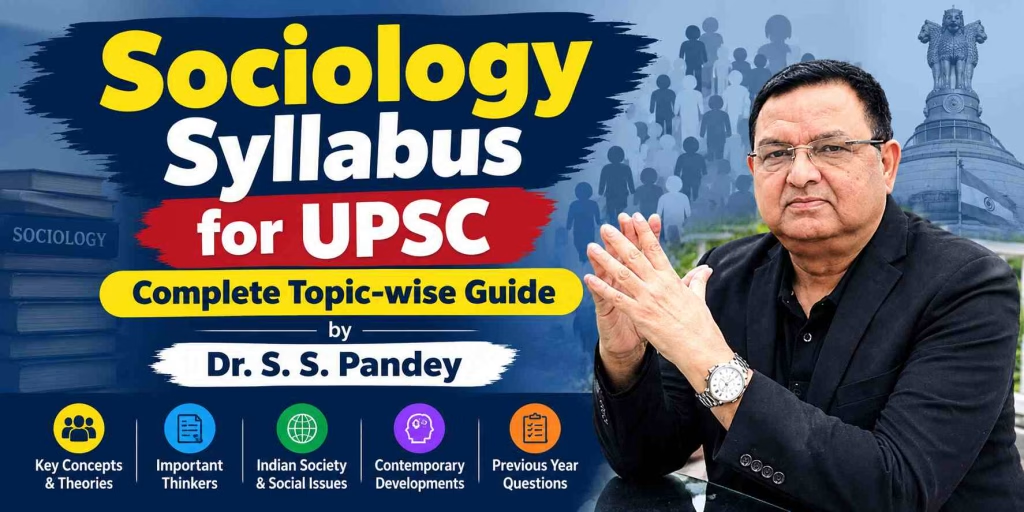
The sociology syllabus for UPSC looks short on paper. Then you open it and meet ten big units in Paper 1 and a long list in Paper 2. Many aspirants close the file and reach for tea instead.
Fair reaction. But the subject is friendlier than it looks. This guide gives you a clean syllabus breakdown, built on real structure and zero guesswork. It follows the way UPSC sociology by Dr. S. S. Pandey is taught at Dikshant IAS, where the syllabus always comes before the notes.
What Is the Sociology Syllabus for UPSC?
The UPSC sociology optional syllabus covers one of the UPSC Mains optional subject choices. It has two papers, and each carries 250 marks, so the subject adds up to 500 marks. Paper 1 covers Fundamentals of Sociology. Paper 2 covers Indian Society: Structure and Change. Sociology plays no part in UPSC Prelims.
The Union Public Service Commission (UPSC) conducts the Civil Services Examination for the Indian Administrative Service (IAS), Indian Police Service (IPS) and Indian Foreign Service (IFS). Your optional subject selection carries 500 of the 1,750 written marks, so choose with care.
What Is in Paper 1 of the Sociology Optional?
Paper 1 sets the base. This sociology syllabus Paper 1 has ten units, and the sociology optional Paper 1 topics are mostly theory. The sociology optional topic-wise syllabus runs like this:
- Sociology: The Discipline. Modernity, the emergence of sociology, its scope, and sociology versus common sense.
- Sociology as Science. Scientific method, positivism and its critique, objectivity, and non-positivist methods.
- Research Methods and Analysis. Qualitative and quantitative methods, data collection, sampling, hypothesis, reliability and validity.
- Sociological Thinkers. Karl Marx, Emile Durkheim, Max Weber, Talcott Parsons, Robert K. Merton, and George Herbert Mead.
- Stratification and Mobility. Inequality, hierarchy, poverty, exclusion, and theories of stratification, plus open and closed mobility.
- Works and Economic Life. How work is organised in different societies, including formal and informal work and labour.
- Politics and Society. Power, bureaucracy, political parties, nation, state, citizenship, democracy, and social movements.
- Religion and Society. Theories of religion, religious practices, secularisation, revivalism, and fundamentalism.
- Systems of Kinship. Family, household, marriage, descent, patriarchy, and the sexual division of labour.
- Social Change in Modern Society. Theories of change, development and dependency, and the role of education, science, and technology.
That is the paper-wise structure. Thinkers show up across almost every unit, so thinker-based answers matter here.
What Is in Paper 2 of the Sociology Optional?
Paper 2 turns the theory toward India. The sociology syllabus Paper 2 has two parts, and the sociology optional Paper 2 topics are rich in examples.
- Part A, Introducing Indian Society. Perspectives from Indology (G.S. Ghurye), structural functionalism (M.N. Srinivas), and Marxist sociology (A.R. Desai), plus the impact of colonial rule, nationalism, and social reforms.
- Part B, Social Structure in India. Rural and agrarian structure, caste, tribal communities, social classes, kinship, and religion.
- Part B, Social Changes in India. Visions of change, agrarian transformation, industrialisation, urbanisation, politics, social movements, population dynamics, and the challenges of social transformation.
Here is the good news. Paper 2 overlaps with the static and dynamic portions of GS Paper 1, such as caste, urbanisation and population. Current affairs feed these topics all year.
Paper 1 vs Paper 2: How Do They Compare?
The table below gives a quick view of both papers.
| Feature | Paper 1 | Paper 2 |
| Title | Fundamentals of Sociology | Indian Society: Structure and Change |
| Marks | 250 | 250 |
| Main focus | Theory, thinkers, methods | Indian society and change |
| Number of parts | Ten units | Two parts |
| Best linked to | Essay, social theory | GS Paper 1, social issues |
Treat Paper 1 as the toolbox and Paper 2 as the workshop. You use the tools from the first paper to build answers in the second.
Prefer classroom guidance? You can find the location of Dr. S. S. Pandey on the Google Business Profile listing, so search the name on Google Maps and check the address, photos and student feedback before you visit. UPSC sociology by Dr. S. S. Pandey is one option to compare.
Where Can You Find the Sociology Syllabus PDF?
The official sociology syllabus PDF sits inside the Civil Services Examination notification on the UPSC website. It lists the sociology optional detailed syllabus unit by unit. Always check the latest notification before you start, because UPSC can update exam rules. Notes from any institute should never replace that official text.
How Should You Plan Sociology Optional Preparation?
Good sociology optional preparation starts with the sociology syllabus for UPSC, not with a book pile. Print the syllabus, mark each topic, and tick it off after revision. Then follow a simple sociology optional strategy:
- Read the full syllabus twice before you open any book.
- Build conceptual clarity with the NCERT Sociology textbooks for Classes 11 and 12.
- Move to standard sociology optional books for each unit.
- Study one thinker at a time and note their key ideas.
- Solve sociology optional previous year questions to learn the pattern.
- Start answer writing practice early, and add Indian examples.
- Link dynamic topics to current affairs in a short notebook.
Some aspirants prefer guided learning, and that is a fair choice. Dr. S. S. Pandey lectures follow the syllabus order, so topic-wise coverage stays clear. Feedback from a teacher can also shorten the learning curve.
Why Do Aspirants Choose Sociology as an Optional?
Sociology is chosen by candidates on practical considerations. This optional makes use of ordinary concepts like family, caste, and religion. Moreover, this optional is relevant to both the Essay and GS Paper 1. Yet, there is no guarantee of a score based on which optional one chooses. The hard work put in is more important than the name of the optional itself.
Can the Syllabus Help With UGC NET, BPSC and State PCS?
Yes, to some extent. Basic subjects like thinkers, research methodologies, and Indian society are included in the papers of sociology, hence the concepts will carry forward. However, UGC NET, BPSC, and State PCS have different syllabi and patterns. Kindly visit the NTA UGC NET page and the state notification page.
How to Write Better Answers From This Syllabus
Marks come from answers, not from reading. Use thinker-based answers wherever the topic allows. Quote one or two thinkers, add an Indian example, and close with a clear point of view. Keep paragraphs short. Examiners read many copies, so clarity wins.
Common Mistakes to Avoid With the Syllabus
Most errors come from habit, not ability. Watch out for these:
- Reading without writing. Answers need practice, not only notes.
- Skipping thinkers in Paper 1. They support many answers.
- Treating Paper 2 as general knowledge. It needs sociological terms and thinkers.
- Ignoring the notification. Rules can change, so verify first.
How This Guide Was Prepared
This guide follows the unit structure published by the Union Public Service Commission in its Civil Services Examination notification. For reading, it points to NCERT Sociology textbooks, and for NET it points to the National Testing Agency. It makes no rank or score claims, because no source can promise them. Check the official UPSC website for any change after this post.
Final Thoughts on the Sociology Syllabus for UPSC
The sociology syllabus for UPSC is big, but it is not scary. Ten units in Paper 1 and a clear, logical plan in Paper 2 give you a map. Read the official text, build your base, and write answers every week. Small, steady steps beat long, stressful study marathons.
If you want guided support, UPSC sociology by Dr. S. S. Pandey at Dikshant IAS offers a structured route through every unit. Compare it with your options, and choose what fits you best. Start today, revise often, and keep the syllabus close. Dr. S. S. Pandey lectures can be a smart next step.
Frequently Asked Questions
The sociology syllabus for UPSC has two papers. Paper 1 covers Fundamentals of Sociology, and Paper 2 covers Indian Society: Structure and Change. Each paper carries 250 marks, so the optional adds up to 500 marks in UPSC Mains.
Paper 1 has ten units. They include Sociology as a Discipline, Research Methods, Sociological Thinkers, Stratification and Mobility, Politics and Society, Religion and Society, Systems of Kinship, and Social Change in Modern Society.
Paper 2 has two parts. Part A introduces Indian society, including Indology, structural functionalism, Marxist sociology and the impact of colonial rule. Part B covers social structure and social change in India, such as caste, tribes, kinship, urbanisation and social movements.
No. Sociology is an optional subject only in UPSC Mains. UPSC Prelims has no optional paper.
The official syllabus is part of the Civil Services Examination notification on the UPSC website (upsc.gov.in). Check the latest notification before you start, because UPSC can update exam rules.
Yes, partly. Topics like caste, population, urbanisation and social issues in Paper 2 overlap with GS Paper 1. They also help with the Essay paper. The overlap saves time, but it does not replace separate GS preparation.
Many aspirants start with the NCERT Sociology textbooks for Classes 11 and 12 to build basic clarity. After that, they move to standard books for each unit and practise previous year questions.
Partly. Topics like thinkers, research methods and Indian society help across exams. But UGC NET, BPSC and State PCS each follow their own syllabus and pattern, so check each official notification.